Two-wire cable assemblies for automotive applications

Are you looking for an automotive, compact and robust combination for high-performance data transmission up to 20 Gbps and a maximum frequency of 15 GHz?

If so, our two-wire cable assemblies are the perfect solution for your application.
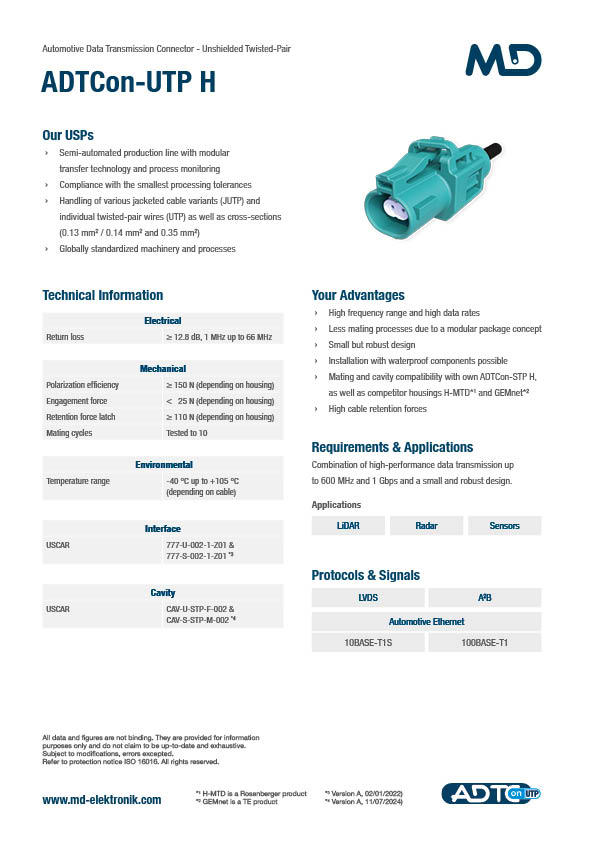
ADTCon UTP

product information

Download

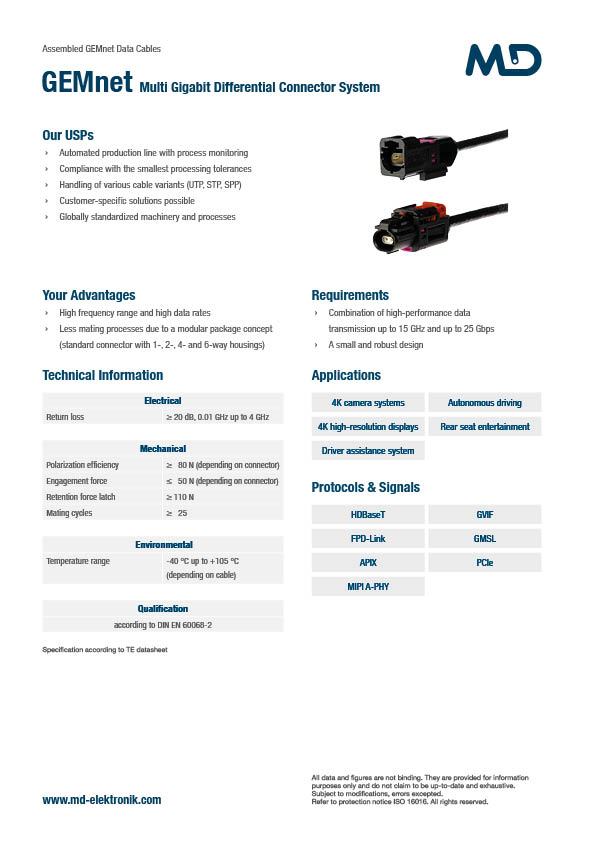
GEMnet

product information

Download

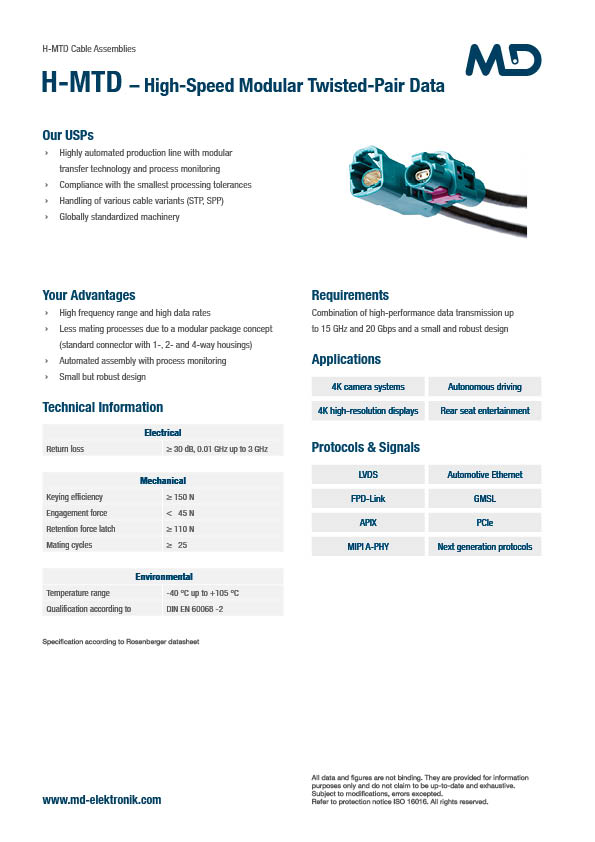
H-MTD

product information

Download

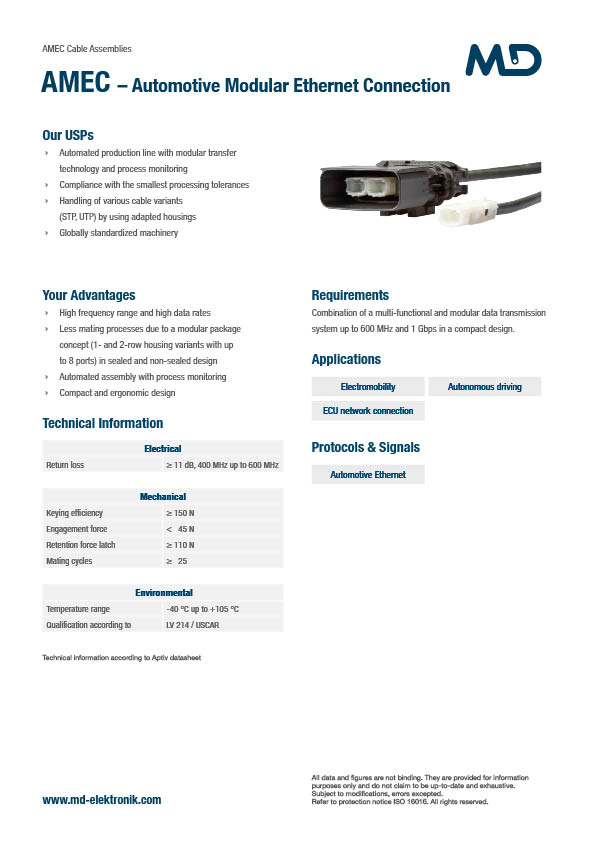
AMEC

product information

Download

BEAMnet

product information

Download

Do you have any questions?

Please contact us now.

Contact

Supplementary / extended product documents

Download

Your advantages

Icon depicting a speedometer, symbolizing the high performance and efficiency of MD ELEKTRONIK's automotive data transmission technologies.

High frequency range and high data rate

  • High frequency range and high data rates (15 GHz and 20 Gbps)
Blue diamond icon representing high-quality standards at MD ELEKTRONIK, symbolizing excellence and precision in automotive components manufacturing.

Consistently high-quality standard

  • Highly automated assembly with automated process monitoring
  • Globally standardized machinery
  • Compliance with the smallest processing tolerances
Blue slider control icon, symbolizing customization and precise control in MD ELEKTRONIK's automotive component manufacturing.

Tailor-made solution with modular concept

  • Handling of various cable variants (STP, SPP, UTP)
  • Sealed and non-sealed connector variants

Saving installation space

  • Compact and robust design
Icon depicting a USB plug with directional arrows, symbolizing MD ELEKTRONIK's focus on reducing electronic waste and enhancing plug-and-play connectivity solutions in automotive systems.

Reduction of mating processes

  • Less mating processes due to a modular package concept (standard connector with 1-, 2- and 4-way housings)
Modern electric vehicle interior featuring a digital dashboard with navigation and climate control display, exemplifying MD ELEKTRONIK's advanced automotive cable solutions for enhanced driver experience.

Applications

4K camera systems Autonomous driving 4K displays Rear seat entertainment Electromobility Automotive Ethernet

Protocols & signals

Successfully implemented projects

Automotive wiring harness diagram by MD ELEKTRONIK showcasing data cable connections in modern vehicle network systems

Control unit connection

Advantages:

  • Miniaturized connection solution
  • High-performance data transmission
  • Application-oriented scalability
Modern electric vehicle interior featuring a digital dashboard with navigation and climate control display, exemplifying MD ELEKTRONIK's advanced automotive cable solutions for enhanced driver experience.

Display connection

Advantages:

  • Miniaturized connection solution
  • Cost-effective
Futuristic autonomous vehicle using MD ELEKTRONIK data cables for advanced LIDAR technology in urban environment

LiDAR connection

Advantages:

  • Miniaturized connection solution
  • High-performance data transmission for real-time data

Technical information

Electrical
Return loss ≥ 30 dB, 0.01 GHz up to 3 GHz (H-MTD) or ≥ 11 dB, 400 MHz up to 600 MHz (AMEC)
≥ 25 dB, 3 GHz up to 6 GHz (H-MTD)
≥ 20 dB, 6 GHz up to 10 GHz (H-MTD)
≥ 15 dB, 10 GHz up to 15 GHz (H-MTD)
Mechanical
Keying efficiency ≥ 150 N
Engagement force < 45 N
Retention force latch ≥ 110 N
Mating cycles ≥ 25
Environmental
Temperature range -40 °C up to +105 °C
Qualification according to DIN EN 60068 -2

Data according to component manufacturer

FAQ

They stand out by a lightweight design along with very high data rates and a high flexibility due to modular housings.

Automotive Ethernet means Ethernet for vehicles with the goal of standardizing the data transmission in the on-board power system. Automotive Ethernet is a core technology for the realization of the future on-board power system.

What is 100BASE-T1? Automotive Ethernet with a data transmission rate of 100 Mbps via a pair of cores.

What is 1000BASE-T1? Automotive Ethernet with a data transmission rate of 1 Gbps via a pair of cores.

OPEN Alliance is a non-profit organization with the goal of specifying Ethernet and the on-board power system for vehicles.

What is the difference between UTP and STP? UTP (Unshielded Twisted Pair) means an unshielded two-wire data cable.
STP (Shielded Twisted Pair) means a single-shielded or multiple-shielded two-wire data cable.

Handling instructions for two-wire cables can be found under the link.

We are happy to assist you with advice.