
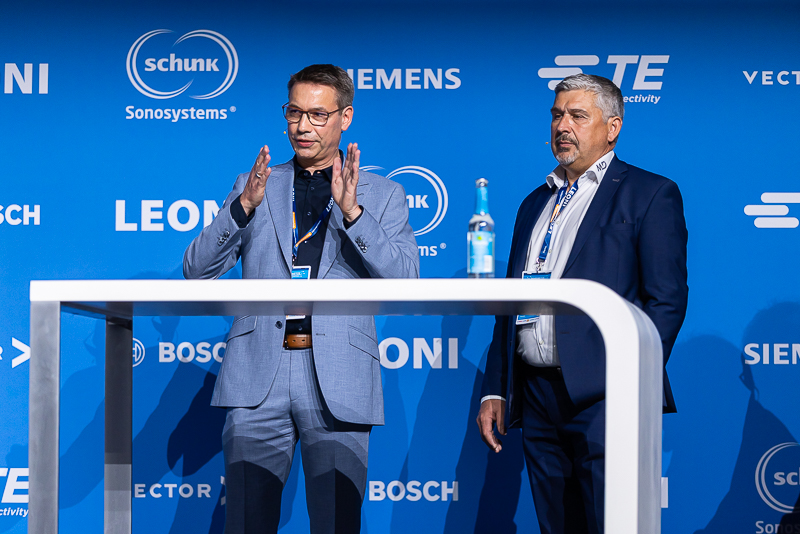
At the 14th International Conference on Automotive Wire Harness & EDS in Ludwigsburg, MD ELEKTRONIK and Bosch jointly held a presentation on “High Frequency Integrated Multi-Hybrid Connector Systems for Future E/E Architectures” highlighting jointly developed multi-hybrid connector systems that already meet demanding OEM specifications for automotive applications. The presentation was given by Martin Hager, Director Center of Competence Mechanical Engineering (ME/ECO-ME) at Bosch Mobility Electronics, and Helmut Pritz, Manager Technical Product Management (Optical Transmission, Multi-Hybrid Connectors) at MD ELEKTRONIK.
Cooperation between Bosch und MD ELEKTRONIK
The collaboration between the two companies focuses on two core solutions: Microflex and Moduflex. These systems enable flexible modularization of future on-board networks and simplify harness separation on both the cable assembly and ECU sides. MD ELEKTRONIK develops and manufactures the high-frequency contact technologies, such as Shielded Twisted Pair and Mini Coax, specifically for the PCB interface in accordance with the respective requirements.
Software Defined Vehicle (SDV)
|
Increasing data rates
|
New on-board system requirements
|
Safety & security
|
Manufacturability and process robustness
|
Variant and cost management
|
Modularization and High Frequency Integration in Connector Systems
The most widely used connector systems in the automotive industry were often developed at a time when data rates and on-board network concepts imposed significantly lower requirements. One of the greatest challenges currently being faced is the integration of high-frequency contacts directly into modular connector systems. This is precisely where the joint development by Bosch and MD ELEKTRONIK comes into play. Both solution concepts focus on advancing connector systems toward greater modularization and high-frequency (HF) integration.

- Connector for HF applications (Catalog product)
- Integrated multipin connector wth HF contacts (various shielding options)
- Fully integrated multipin connector with HF contacts, separate shielding (example)
- Fully integrated modular connector with HF contacts (separate shielding)
The key technical drivers and challenges for optimized multi-hybrid connector systems arise primarily from the increasing requirements of modern E/E architectures. The growing number of functions, sensors, and data channels requires a high packing density within limited installation space. At the same time, the combination of low-speed and high-speed contacts makes targeted pin optimization essential to reliably integrate power supply and high-frequency data transmission within a single system. Optimized assembly and interconnection technologies for integration into central electronic control units (ECUs) are also becoming increasingly important as control units continue to shrink in size. Simplified PCB assembly and fewer mating operations help reduce manufacturing time and potential sources of error. In addition, insertion forces must be reduced to facilitate assembly and prevent damage. Overall, the focus is on lower complexity, greater reliability, and fully automated, robust series production.
Microflex and Moduflex: Solution Concepts for Multi-Hybrid Connector Systems

With Microflex and Moduflex, Bosch and MD ELEKTRONIK have jointly developed two solution concepts for modern multi-hybrid connector systems.
The first solution is based on multipin headers with integrated HF connectors using state-of-the-art soldering technology, while the second solution employs fully integrated modular pin headers with HF contacts based on Press-Fit technology. Both concepts utilize separate shielding, enabling high-performance and scalable integration of high frequency and signal transmission in modern on-board network architectures, particularly in EMC-critical areas (e.g., where potential differences or different current levels for cameras occur).
To meet the demanding requirements for data rates, packing density, and signal integrity, targeted system-level improvements were implemented. Optimizations in Press-Fit technology, tolerance management, shielding design, and fixation elements improve return loss, shielding effectiveness, and coupling attenuation. At the same time, a precisely coordinated overall design enables accurate positioning of pins and PCB drill holes while accommodating a large number of HF modules within the available installation space. This is complemented by optimized PCB routing and extended coding options, allowing flexible integration of different cable modules and variants.
Test Results
The high-frequency and mechanical tests performed confirmed the performance of the developed Microflex and Moduflex multi-hybrid connector systems at the individual component level in accordance with the relevant IEEE, OPEN Alliance, and USCAR standards.
High frequency tests
Differential connectors
- IEEE 802.3ch (2,5 GHz / 5 Gbit/s · 4 GHz / 10 Gbit/s)
- IEEE 802.3cy (9 GHz / 25 Gbit/s)
- LogMag(s21) > −50 dB (0–25 Gbit/s)
Mini Coax connectors
- FPD-Link III (2,4 GHz / ~3,4 Gbit/s)
- GMSL3 (3,5 GHz / ~12 Gbit/s)
- FPD-Link IV (4,25 GHz / ~6 Gbit/s)
- LogMag(s21) > −60 dB (0–9 GHz)
Mechanical tests
The mechanical test results meet the typical requirements for automotive on-board network connectors in accordance with USCAR-2.
- Complete connector system: < 75 N passed
- Mini Coax component: < 12 N passed
- Differential component: > 110 N passed
- Differential component: < 30 N passed
Summary of the Benefits of Multi-Hybrid Connector Systems
The presented multi-hybrid connector systems meet the key requirements of future E/E architectures and provide the foundation for more powerful, flexible, and efficient vehicle platforms. At the same time, they support a greater degree of standardization of interfaces and processes throughout the entire value chain—from control unit integration to on-board network assembly.
Tier 1 (ECU)
- Double pin density
- Robustness
- Miniaturization
- Interconnection technology possible (e.g. press-fit)
- High-speed integration
Standardization
- OPEN interface
- Cost savings
- Flexibility (sealed / unsealed)
- Scalability
- Full modularity
Tier 1 (Wire harness)
- UTP / STP / SPP* cables
- Reduced complexity on the on-board network
- Fewer mating operations on the on-board network
- Automated assembly
- Standardized connectors
* SPP = shielded parallel pair
The development has reached a high level of maturity and is already being successfully used in ECU demonstrators for functional and validation testing. Based on a modular cartridge concept, different signal, data, and power transmission technologies have been integrated into a single demonstrator system and tested under conditions closely resembling real-world applications.

You might also be interested in


This corporate blog is for general information and marketing purposes and is not a controlled document of our quality management system (QMS). Translations may be produced with automation and are editorially reviewed; despite due care, errors are possible—only the officially published product documents are authoritative.